


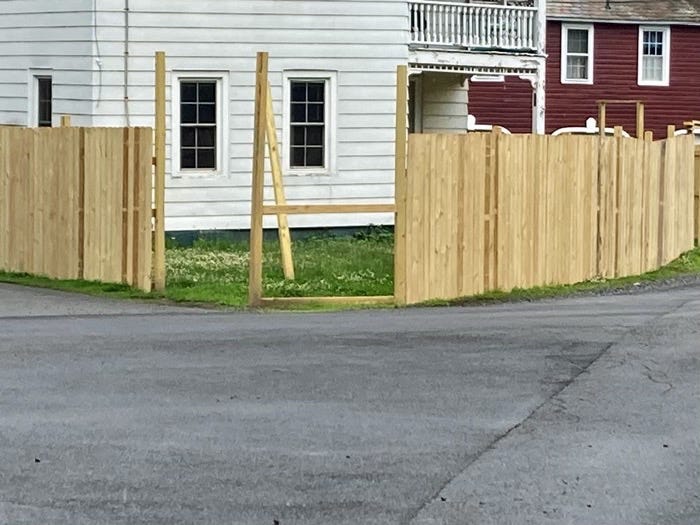
Lurching into high summer, we take a break from the monumental grandiosity of High Architecture and focus on a small, but not unimportant, matter of civic design that applies especially to the American small town. What’s wrong with the picture above? I will tell you.
The everyday built environment is not just a collection or succession of things sitting on the terrain. It consists of relationships between them. A window is not a mere hole in the wall of a building, it is a relationship between the inside of the building and the outside. It is a transition between the two.
Likewise, a fence is a device of transition. It informs the citizen-at-large that the public realm of street meets and transitions into the private realm of the front yard, and ultimately the house. There are better and worse ways of doing this. A stockade fence is one of the worse ways because it is brutal and crass, like sticking your hand in the face of someone trying to speak to you.
Ideally, in the small town setting, you would want gentle transitions between public space and the private realm. And also, ideally, the private realm would show some generosity toward the street. It would share something of itself to the public, something worth sharing. All of which explains why the best fences in residential neighborhoods are semi-transparent.
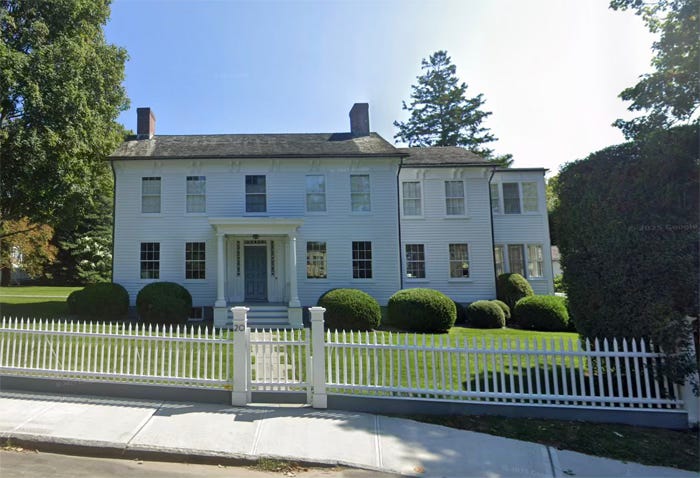
You can see through (and over) this fence. The property owner shows some generosity to the people on the street. You are allowed to see the house, and if the house contains some design grace notes, so much the better. The one above is rather austere. Its chief virtue is its clean, classic proportioning. But you are allowed to look through and over the pickets to see it. Don’t you like to see the houses along the street as you pass by? Of course you do.
Now, I will tell you why you see so many stockade fences in American towns: the automobile creates chaos in the street, even in a small town residential street, low-grade chaos. Even that much dissonance in your environment prompts self-defense. The house (the home-owner, that is) does not feel generous toward the street. He doesn’t want to share anything with the street and these menacing things moving in it. He wants to block it out, pretend that it’s not there. It’s a simple as that.
Bottom line: the people who manage your town and write the design codes must be careful to code the residential streets in favor of fences you can see through, and code against stockades and high walls, except under special circumstances. The outcome, I promise you, will be better looking towns. . . places you will enjoy walking around. Now, onto summer and all its pleasures!

Eyesore of the Month is sponsored by Sage Restoration.
A stockade fence as a side fence is what I need so I don't have to watch my "neighbor" work on cars, trucks, and motorcycles every day. Grinding, blowing, banging and starting super loud engines 20 feet away. This whole urban neighborhood is a shit hole.
Well the stockade fence may not be the most welcoming edifice but it sure beats what I witnessed in the City of Hartford a few days ago, which was bars in the windows of the first few floors of numerous apartment houses, and on top, on the roof, coils of barbed wire spooked out to presumably keep out invaders. If that doesnt say "High trust society" I dont know what does! Street level businesses -- mostly smoke shops and bodegas -- featured bars on windows and doors, high security locks, cameras and rolltiop steel doors they pulled down when the business day is over (which invariably are covered with grafitti) There you have it, an inviting streetscape. City beautiful.