


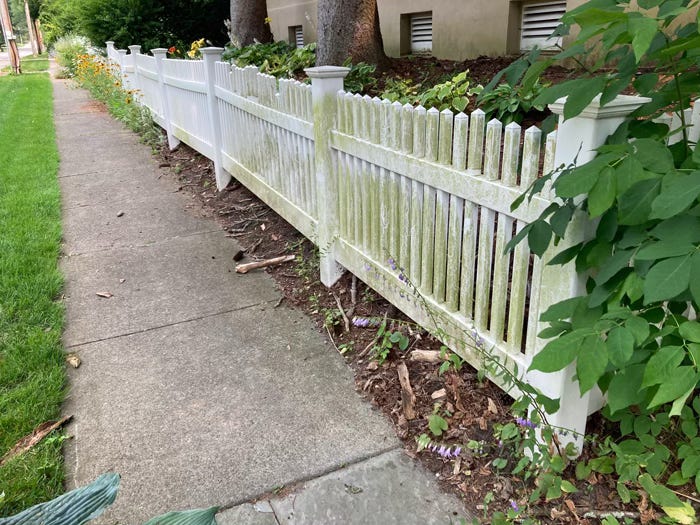
We continue the summer disquisition on a very particular issue of urban design: the fence — because it is the small details that add up to a big picture of how your town presents itself — and how that presentation makes you feel. Last month, it was the stockade fence around the front of a house, sending all the wrong messages about the relationship between private property and the public realm. This month it’s the issue of plastic fences, such as the one above.
There is a mechanism in our neurology that revolts against fakery, especially things made of plastic when they are deployed among things found in nature. Is there anything more depressing, for instance, than a child’s discarded once-brightly colored plastic plaything deployed in the weeds of a neglected yard? A trike or a deflated wading pool. The colors are faded from exposure to ultraviolet light, and coated with a creeping patina of mold.
You sense that even in decomposition it is not returning-to-nature because it is not a natural thing in the first place. It will ultimately deteriorate into micro-plastic particles that get into the eco-system as alien material and end up lodged in the workings of living organisms: bugs, fish, mice, ‘possums, and on upward in the chain. Eventually, a lot of micro-plastic ends up in you!
Behold the plastic fence above. Like a lot of things in this world, it probably seemed like a good idea at the time. Cheap. Effective for preventing walked dogs from shitting in your flowers. Looks like an old-timey wooden picket fence. It’s trying hard to say that it’s charming. (Fail.)
But then the years pass. The casual pedestrian comes by. He sees the green algae spreading on the pickets, he sees the broken pickets. His mind no longer registers charming picket fence. It registers decrepitating plastic junk. Another thing we register subconsciously is the essential lie that comes with the sales pitch: maintenance not required. This is the basic lie of all plastic material; that you don’t have to take care of it. You don’t have to paint it periodically or replace parts here and there — as in the pickets or posts of a wooden fence when they rot out. You can observe this vividly in houses with vinyl siding. Because vinyl promises no maintenance it doesn’t get maintained, not even cleaned once in a while. That’s why such houses collect those automobile exhaust emissions in grimy streaks and patches under the soffit and the eaves, and pieces fall off or dangle.
Yes, it’s a complex and perhaps esoteric dynamic between materials used to build things and human cognition, but it’s for real. So, the bottom line is: don’t do it. Don’t buy plastic crap if you can possibly help it. Every little bit of it contributes to the degradation of our culture. Buy better. . . do better. . . be better!
I'm going to raise an objection this time. I live in the deep South. A fence like that made of wood will last 5 - 10 years before it rots away to nothing. Pressure treated wood - rots away. Cedar - rots away. Redwood - rots away. Teak - maybe - if you can afford a $25,000 fence.
And that is not mold on the fence, it's algae. In a hot humid environement it grows everywhere. There is a product called "Wet and Forget", Costco, Walmart, amazon sell it. You spray it on, the algae disappears. Do it once a year.
My mom lives about 400 miles north of Mr. Kuntlser in Montreal Canada. There a plain untreated pine fence lasts 20, 30, 40 years because of sub-freezing temps half the year. She has one. An untreated pine fence in my yard would be gone in 2 years.
Sometimes practicality has to trump aesthetics.
I agree! Unfortunately, there is often no natural alternative to so many things. I love the brushed nickel towel bar for inside the shower that was just delivered. It came in a box that said "Metal First, No Plastic Parts." However, it was made in China. I look forward to the future when most products are manufactured onshore. Great post@